
Linked Open Data (LOD) for heritage
Linked Open Data (LOD) is an international standard for publishing collection information in a machine-readable and semantically unambiguous way. This allows search engines, data systems and AI applications to better interpret the meaning and make connections between objects, creators, places and events - inside and outside the heritage sector.
On this page you will read:
- What Linked Open Data is (clearly explained),
- How LOD works with identifiers and relationships,
- Which publishing routes are available (JSON-LD/schema.org or SPARQL),
- And how to practically start.
What is Linked Open Data?
Linked data means: publishing data with stable identifiers and standardized relationships, so that information is not "separate" but becomes part of a network.
Open means: freely reusable, where possible. If your data cannot (yet) be completely open, you can often apply linked data with limited access.
LOD turns "information in a system" into information that can link.
How does LOD work?
LOD describes information as unambiguous statements about something. It is usually in the form: subject - predicate - object (aka: a triple). Example:
- This object → has type → picture
- This object → was created by → Mieke Jansen
- This object → is about → Roermond
- This object → was created in → 1984
Why Linked Open Data?
With Linked Open Data you can:
- connect collections between organizations, without custom links each time
- accelerate reuse for websites, apps, portals and research
- sustainable publishing (less reliance on exports and one specific system)
- Increase consistency (one meaning, multiple uses)
- enable new insights through connections between collections and resources
Practical effect: less manual interpretation on exchange, less "mapping by project," and more scalability.
A workable LOD roadmap:
- Define purpose (findability, reuse, research, links)
- Choose your publishing format (JSON-LD, dump, SPARQL)
- Inventory core entities (object, creator, place, event, concept)
- Make identifiers stable (so links don't break)
- Standardize terms and relationships (so that links are meaningful)
- Publish, validate and improve (quality, coverage, consistency)
Relationship to NDE compatible working
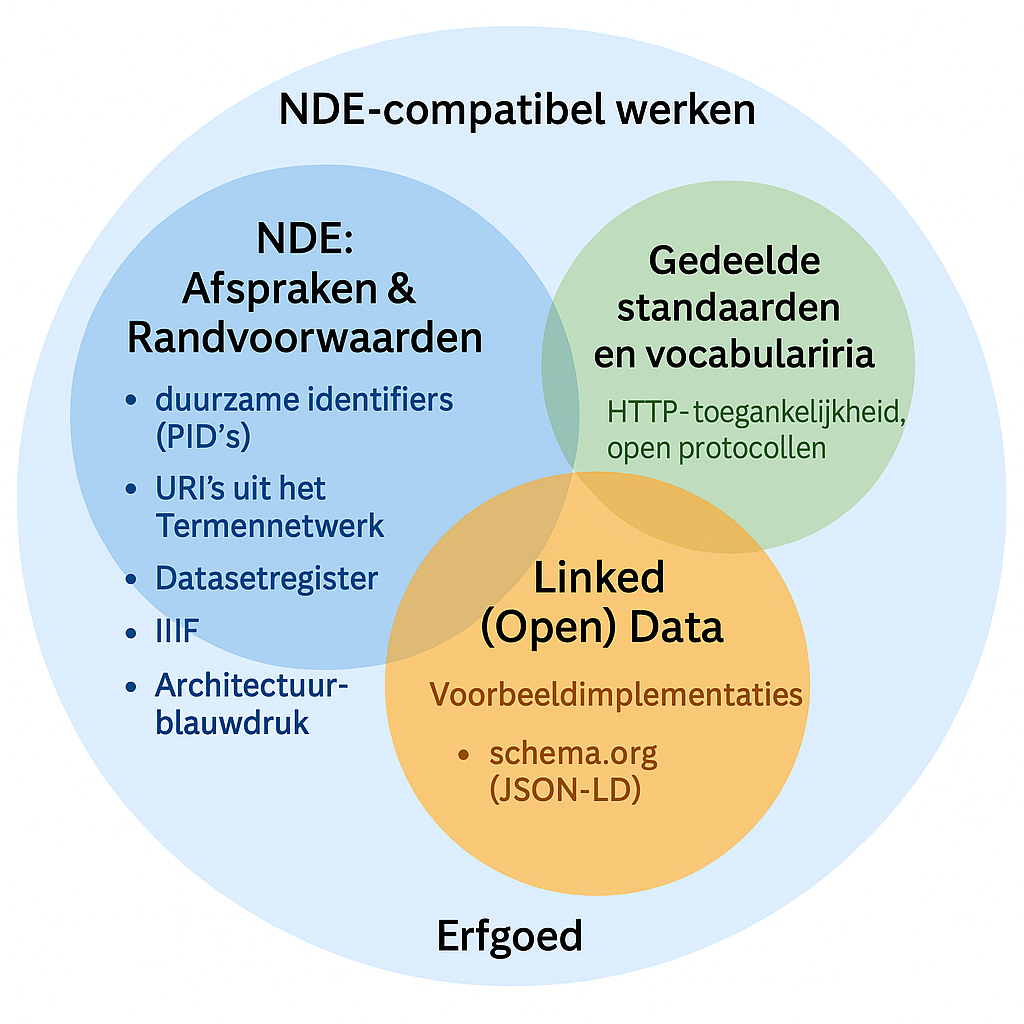
Linked Open Data aligns with agreements around NDE-compatible working. Read also: NDE-compatible working for heritage.
The main LOD building blocks
Identifiers (URIs/PIDs).
Each object, person, place or concept is given a unique, persistent reference (e.g., a URL) so that others can always link to it, even as systems change.
Relationships (predicates)
You use standardized relationships as is created by or passes over so that others can interpret your data consistently.
Links to other sources
For example: a creator refers to a person source, or a place to a geographic source. This creates a web of references, which is the "linked" part.
How do you publish Linked Open Data?
There are roughly two routes. They connect: you can start low-key and scale up later.
Schema.org as a practical route to Linked Open Data
In the commercial world, it has been common practice for years: Web pages are enriched with schema.org metadata so that search engines can better understand the content. In the heritage sector, this approach is still at the beginning, but the impact is significant.
With schema.org and JSON-LD, you can:
- Making information on Web pages readable by search engines (SEO 2.0);
- Create Linked Data directly at the source without additional infrastructure;
- publish structured data without technical complexity;
- Provide a foundation for cross collection applications.
For heritage organizations, schema.org is therefore both an SEO tool and a LOD tool. Polder Knowledge often uses schema.org as a low-threshold first step toward fully NDE-compatible working. Choose schema.org when:
- You want to get started with open data in a low-threshold way;
- SEO and visibility play an important role;
- you want to enrich pages directly with JSON-LD without additional infrastructure;
- You are looking for a lightweight solution that fits well with limited time or capacity;
- You want to grow step-by-step toward full LOD.
SPARQL endpoints as full Linked Open Data accesses
Where schema.org provides a lightweight, accessible form of structured data, a SPARQL endpoint goes a big step further. An endpoint provides full, dynamic and queryable access to a collection's underlying Linked Open Data. That means machines - and therefore researchers, platforms and apps - can ask complex questions such as relationships between objects, people, places and events.
SPARQL is thus the most complete form of LOD publishing: ideal for organizations that want to share, analyze or link their data broadly within a semantic network.
Choose a SPARQL endpoint when:
- you want to publish your collection fully as Linked Open Data;
- researchers or institutions are your primary target audience;
- semantic relationships (SKOS, RDFS, OWL) are important;
- You want to provide queryable, dynamic access to complex data sets;
- You have, or want to build, a mature LOD infrastructure.
Ready to connect your heritage to the national infrastructure?
With Linked Open Data, exchange becomes less manual and creates space for new connections across organizations. Polder Knowledge guides you from initial publication in JSON-LD to a robust LOD architecture with SPARQL, including data modeling, publication strategy, implementation and quality control. Schedule a free consultation and explore the best route for your organization.